
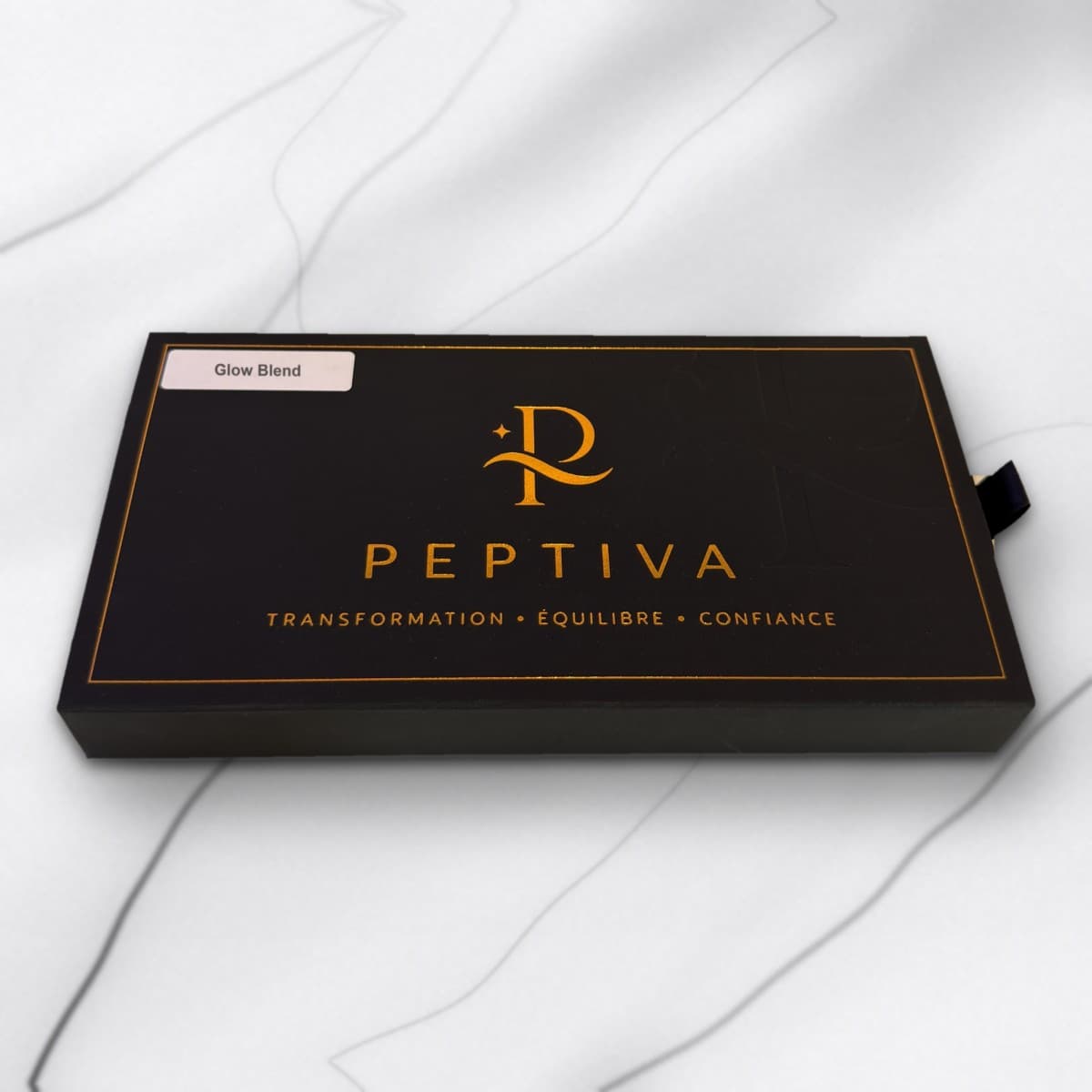
Glow Blend
Combined skin and tissue formula: GHK-Cu, BPC-157, and TB-500
Blood levels of GHK-Cu, the copper peptide in the Glow Blend, drop by about 60% between age 20 and 60: from 200 to 80 ng/mL (Pickart, 2015).
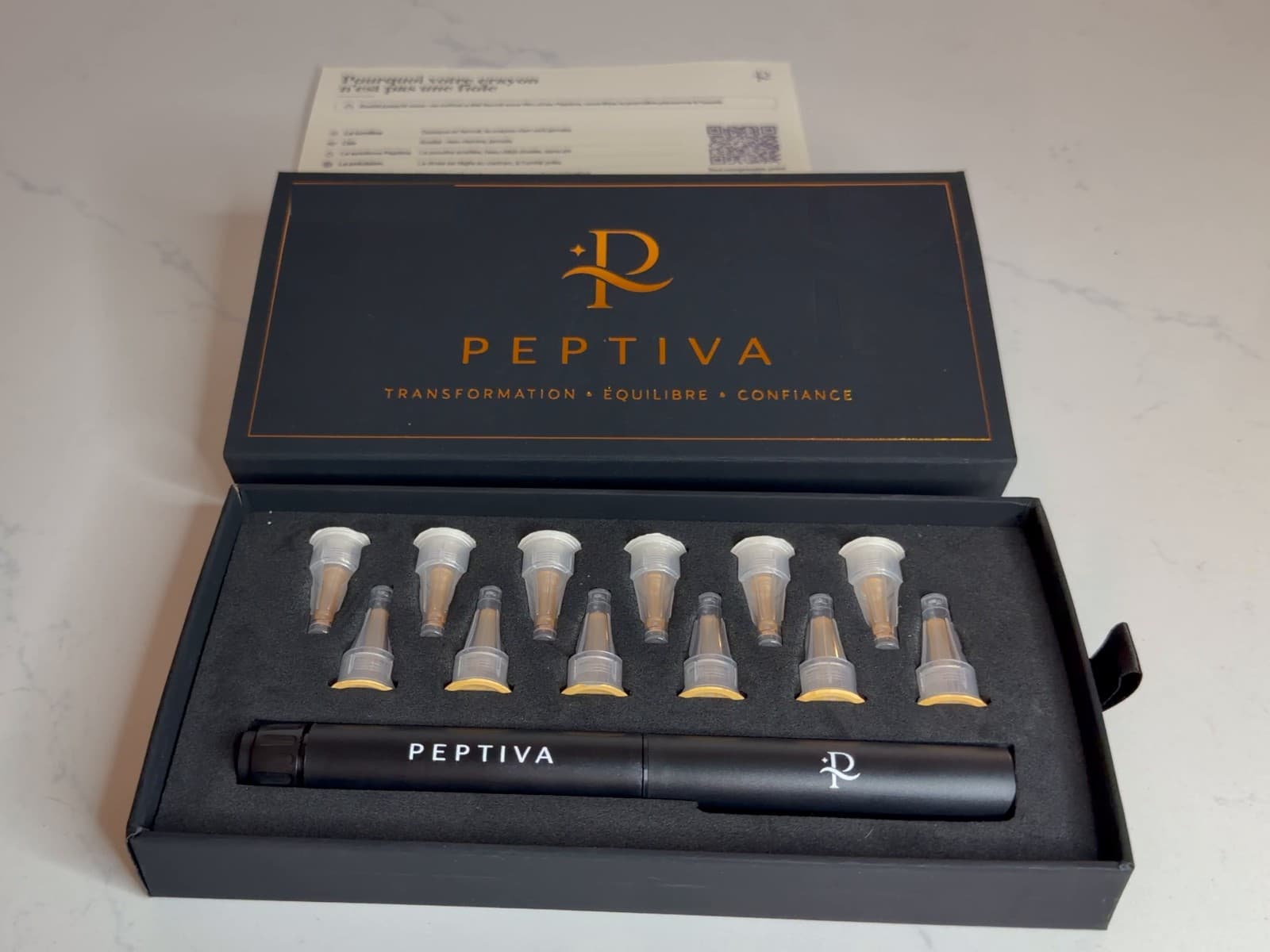
The Glow Blend combines three peptides in one pen: GHK-Cu, studied for collagen and elastin, BPC-157, studied for blood vessel formation, and TB-500, studied for cell migration and fibrosis.
As a cream, GHK-Cu increased collagen production in 7 people out of 10, versus 5 out of 10 with vitamin C and 4 out of 10 with retinoic acid (Abdulghani, 1998).
- Half-life
- Short for all three; the effects work through gene expression and tissue rebuilding, which last for weeks.
- Route
- Subcutaneous injection, a single pen.
Technical sheet
- Family
- Combined skin and tissue formula: GHK-Cu, BPC-157, and TB-500
- Half-life
- Short for all three; the effects work through gene expression and tissue rebuilding, which last for weeks.
- Route
- Subcutaneous injection, a single pen.
- Time to effect
- Firmness and density: three months of application in the GHK-Cu cream trials, the time it takes for new collagen to be laid down. The other timelines come from laboratory research.
- Level of evidence
- Laboratory research : In humans: no trial of the injected blend; GHK-Cu only as a cream on the skin; BPC-157, three small studies without a control group; TB-500, eye-drop trials of the full protein (thymosin beta-4), none of the injected fragment.
Chemical identity
GHK-Cu
- Form
- Copper(II) complex of the GHK tripeptide (1:1)
- CAS No.
- 49557-75-7
BPC-157
- Form
- Synthetic peptide, values for the base form
- CAS No.
- 137525-51-0
TB-500
- Form
- Acetylated fragment 17-23 of thymosin beta-4 (Ac-LKKTETQ), values for the base form
Salt form: as stated on the lot's certificate of analysis.
GHK-Cu: collagen and elastin
GHK-Cu increases the expression of the genes for collagen (types I and III), elastin and hyaluronic acid, and modulates the metalloproteinases that remodel old collagen. Its copper feeds lysyl oxidase, the enzyme that welds collagen fibres together.
BPC-157: blood vessels and fibroblasts
BPC-157 stimulates the formation of small blood vessels (VEGFR2, Akt-eNOS pathway) and the migration of fibroblasts, the cells that make collagen.
TB-500: cell migration and fibrosis
TB-500 binds actin, which lets repair cells move; its parent protein limits inflammation and fibrosis.
Three components in one pen
Collagen formation goes through three stages: the signal that triggers its synthesis, the blood supply and the control of inflammation. GHK-Cu, BPC-157 and TB-500 are each studied for one of these stages.
Studied effects and observed timelines
Radiance and hydration: GHK-Cu increases hyaluronic acid and glycosaminoglycans
In the laboratory, in cells
Firmness and density: as a cream, three trials measured firmer, denser skin
In humans, as a cream: three months of application
Healing: thymosin beta-4 sped up the regrowth of skin over a wound by up to 61% (Malinda, 1999)
In the laboratory: by day 7
What you may feel
- Reaction at the injection site.
- Brief fatigue or mild headaches in the first few days.
- Brief dizziness reported on occasion (GHK-Cu).
Stop and consult if
- Allergic reaction (hives, facial swelling).
- Intense fatigue that persists.
When to abstain
- Active cancer or a recent history of it.
- Pregnancy or breastfeeding.
- Wilson's disease or any disorder of copper metabolism.
- Minors.
Anti-doping : Two of the three components (BPC-157, TB-500) are prohibited by the World Anti-Doping Agency.
The effects to watch for, and how to reduce them
This sheet is educational. It replaces neither a diagnosis nor follow-up: for any medical condition, pregnancy, breastfeeding or current medication, talk to a health professional.
GHK-Cu, the main component, has human trials as a cream; BPC-157 and TB-500, a laboratory base on repair and wound healing (see their entries). No trial has tested the injected blend: the combination rests on the complementarity of the three mechanisms.
1998 · Abdulghani et al., Disease Management and Clinical Outcomes
Pilot study in 20 people: creams applied to the skin of the thigh for one month, biopsies before and after
Increased collagen production in 7 people out of 10 with the GHK-Cu cream, versus 5 out of 10 with vitamin C and 4 out of 10 with retinoic acid. The study measured collagen under the skin, not facial wrinkles or firmness.
2015 · Pickart, Vasquez-Soltero and Margolina, BioMed Research International
A review of three controlled 12-week trials in 41 to 71 women, with a GHK-Cu cream applied to the skin
As a cream on the skin, these trials report, depending on the trial, an improvement in wrinkles, laxity, density, and firmness of the skin. No trial has studied the injection or the blend: these are results for a cream of GHK-Cu alone.
2014 · Pickart et al., BioMed Research International
Gene-expression analysis in cultured human cells (Broad Institute Connectivity Map)
GHK changes the activity of about 4,000 genes by 50% or more, in a direction that favours tissue repair and reduced inflammation according to the authors.
1999 · Malinda et al., Journal of Investigative Dermatology
Experimental full-thickness wound model, thymosin beta-4 applied to the wound or injected
Regrowth of skin over the wound (re-epithelialization) rose by up to 61% on day 7 compared with saline.
2010 · Goldstein et al., Expert Opinion on Biological Therapy
A synthesis of the work on thymosin beta-4, the full protein whose region TB-500 reproduces, in wound healing (skin, cornea, heart)
Faster wound closure and reduced inflammation, with early human data on skin, for the full protein.
Glow Blend or GHK-Cu alone?
GHK-Cu alone targets the skin: collagen, elastin, hyaluronic acid. The Glow Blend adds BPC-157, studied for blood vessel formation and tendons, and TB-500, studied for cell migration and fibrosis.
Why three peptides in one pen?
GHK-Cu alters the expression of at least 4,000 human genes in cells, in the direction of repair according to its authors, BPC-157 activates VEGFR2, the receptor that drives blood vessel growth, and thymosin beta-4, whose active region TB-500 reproduces, sped up the regrowth of skin over a wound by up to 61% on day 7.
Three stages of collagen formation in a single injection.
How long before you see a difference?
Radiance and hydration are reported within a few weeks. Firmness and density follow: those are what the GHK-Cu cream trials measured.
Glossary (5)
- Collagen
- The structural protein that gives skin and tissue their strength.
- Elastin
- A protein that lets skin spring back into shape after stretching.
- Dermis
- The deep layer of the skin, home to fibroblasts and collagen.
- Metalloproteinases
- Enzymes that cut up old collagen to allow remodelling.
- Complete protocol
- A formula that brings several complementary peptides together in a single pen.