
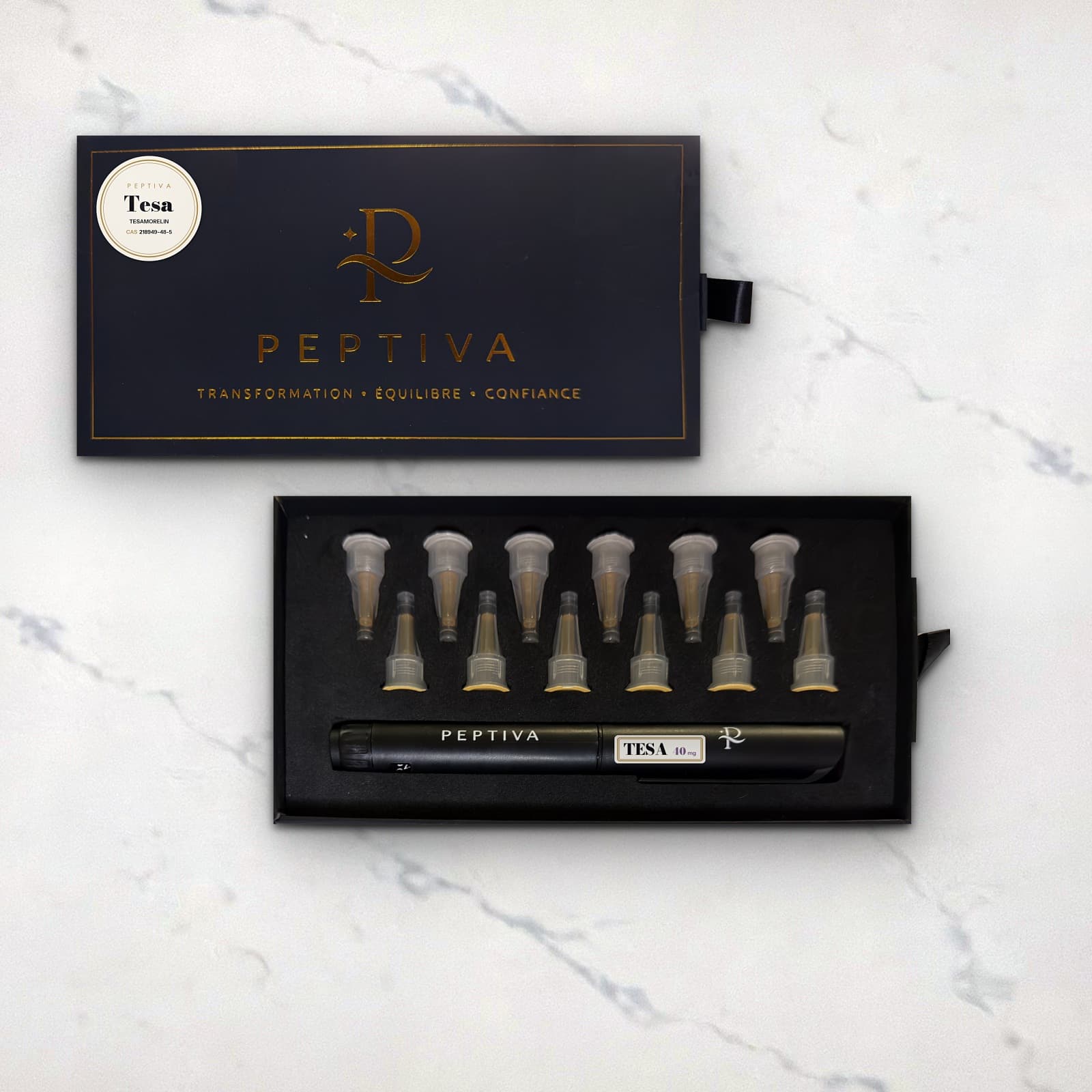
Tesamorelin
Full-length GHRH analogue (44 amino acids), stabilized
GHRH is the hormone that triggers growth hormone release.
In the phase 3 trials, deep abdominal fat, measured by imaging, fell by up to 17.5% on average while it rose on placebo, and the fat under the skin was preserved.
It is an analogue of the full GHRH, all 44 amino acids, with a hexenoyl group that protects it from the DPP-4 enzyme. Its molecule is the active ingredient of a prescription drug approved in the United States.
It is also studied for executive function: in 152 adults aged 55 to 87, a trial measured a favorable effect on planning and switching between tasks (Baker, 2012).
- Half-life
- About 25 to 40 minutes; the growth hormone pulse comes within the hour.
- Route
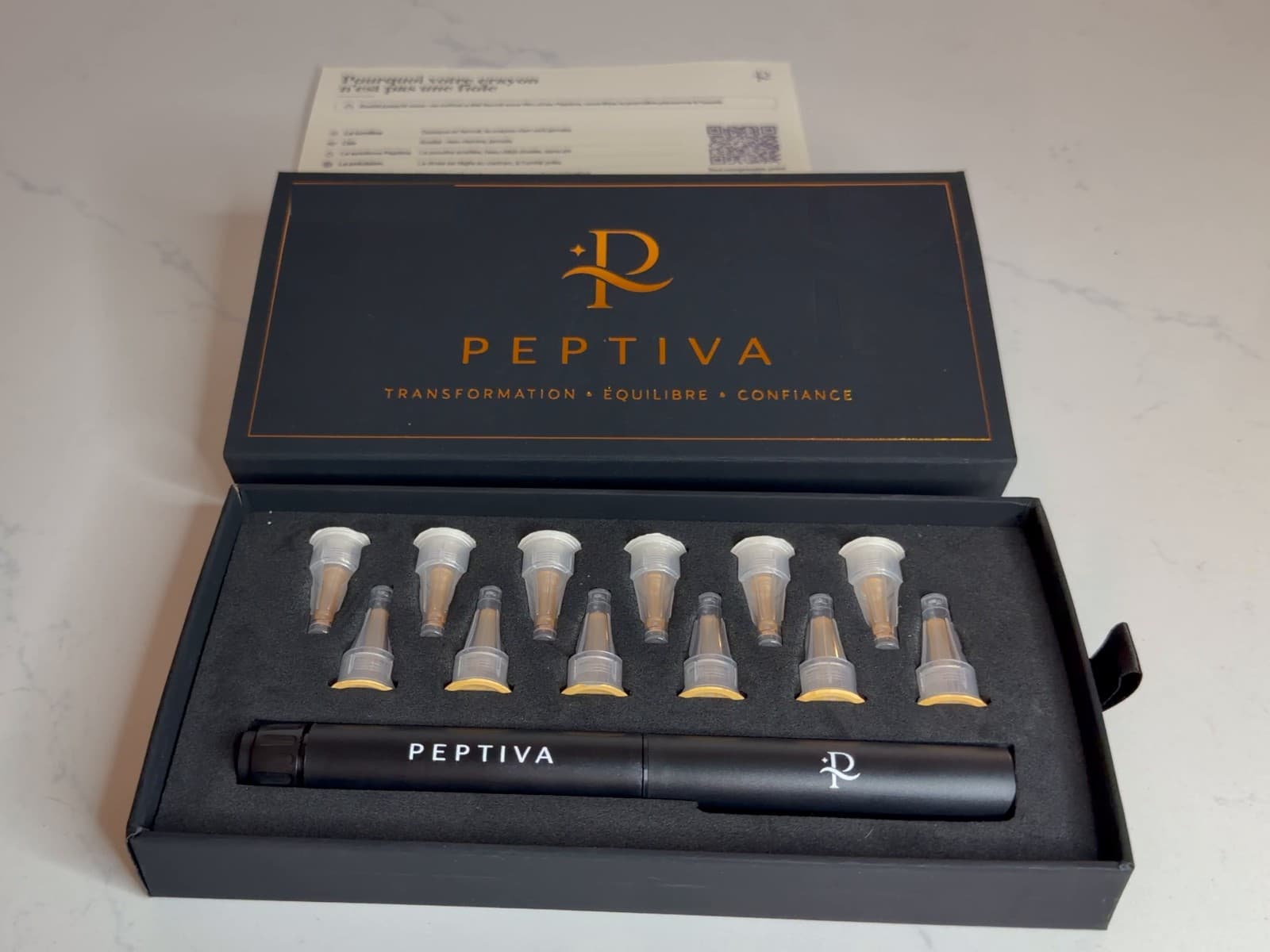
- Subcutaneous injection (into the belly in the trials), on the schedule of the protocol provided with the product.
Technical sheet
- Family
- Full-length GHRH analogue (44 amino acids), stabilized
- Half-life
- About 25 to 40 minutes; the growth hormone pulse comes within the hour.
- Route
- Subcutaneous injection (into the belly in the trials), on the schedule of the protocol provided with the product.
- Time to effect
- IGF-1 higher within one to two weeks; deep abdominal fat was measured after three to six months in the trials.
- Level of evidence
- Documented in humans : In humans: mostly adults living with HIV who have excess abdominal fat; one trial in adults over 55.
Unlike CJC-1295, which keeps only the first 29 amino acids of GHRH, tesamorelin keeps the whole sequence.
Chemical identity
- Chemical name
- [trans-3-hexénoyl]hGRF(1-44) amide
- Form
- Synthetic peptide, values for the base form
- CAS No.
- 218949-48-5
Salt form: as stated on the lot's certificate of analysis.
The whole GHRH, stabilized
Tesamorelin keeps the complete sequence of GHRH (growth hormone-releasing hormone), with a small chemical group at its tip (a hexenoic acid): it thus escapes the DPP-4 enzyme, which cuts natural GHRH within minutes, without any change in how it binds to the receptor.
A release on command, not a hormone supplied
Tesamorelin contains no growth hormone: it makes the pituitary gland release its own, in pulses. That release stays under the body's feedback control (somatostatin brakes, IGF-1 reports back), unlike a growth hormone injection, which imposes its own level.
Why the deep belly fat
Growth hormone mobilizes fat (lipolysis), and visceral fat, packed around the organs, is especially responsive to it. Measured by imaging in the trials, it decreased, while the fat under the skin of the belly and on the limbs changed little.
Effects and realistic timelines
Growth hormone axis: IGF-1 up 81% in the reference trial (2007)
One to two weeks
Deep abdominal fat: up to 17.5% less, measured by imaging
Three to six months
Lower triglycerides: down 50 mg/dL, versus up 9 on placebo (2007)
Three to six months
Executive function: a favorable effect measured in 152 adults aged 55 to 87 (2012)
About five months
What you may feel
- Injection-site reaction: redness, itching, slight pain.
- Joint or muscle aches, aches in the arms or legs.
- Water retention: swelling of the hands, feet or ankles.
- Tingling or numbness in the hands.
- Slightly higher blood sugar at the start of use.
Stop and consult if
- Tingling or numbness in the hands that persists or gets worse.
- Marked swelling of the hands, feet or ankles.
- Intense thirst, abundant urination.
- After an injection, a rash that spreads over the body or swelling of the face.
When to abstain
- Active cancer or recent history of cancer.
- Uncontrolled diabetes.
- Pregnancy or breastfeeding.
- A disorder of the pituitary gland or hypothalamus: pituitary surgery or removal, pituitary insufficiency, tumour, radiation therapy or trauma to the head.
- Known allergy to tesamorelin.
- Minors.
Anti-doping : Prohibited by the World Anti-Doping Agency (GHRH and its analogues, tesamorelin named explicitly, S2).
The effects to watch for, and how to reduce them
This sheet is educational. It replaces neither a diagnosis nor follow-up: for any medical condition, pregnancy, breastfeeding or current medication, talk to a health professional.
To avoid
- CJC-1295, with or without DAC, alone or in the combined formula: two GHRH analogues on the same receptor.
- Exogenous growth hormone: added effects, natural rhythm lost.
- Insulin or diabetes medications without medical supervision: growth hormone can raise blood sugar, and their dose may need to be reviewed.
- Cortisone taken to replace what the adrenal glands no longer make, anticonvulsants, sex hormones or cyclosporine, without medical supervision: growth hormone can change how the body activates or clears them.
Two phase 3 trials (more than 800 participants, 26 weeks) measured a drop in deep abdominal fat and triglycerides and a rise in IGF-1, with no notable change in average blood sugar.
It is the active ingredient of a prescription drug approved in the United States for excess deep abdominal fat in adults living with HIV; it was also approved in Canada, where it is no longer marketed.
In the trials, the effect on fat did not last after stopping. Outside of adults living with HIV, the data is more limited: the results do not automatically carry over to other people.
2007 · Falutz et al., New England Journal of Medicine
412 adults living with HIV and excess abdominal fat, 26 weeks, versus placebo
Deep abdominal fat down by about 15% (up 5% on placebo), triglycerides down, IGF-1 up, average blood sugar unchanged. More dropouts for side effects than on placebo.
2008 · Falutz et al., AIDS
Extension of the same trial to 52 weeks, with a group switched to placebo
The drop in deep fat held in those who continued, without worsening blood sugar; in those who stopped, it came back. The effect lasts as long as the use.
2012 · Baker et al., Archives of Neurology
152 adults aged 55 to 87, healthy or with mild cognitive impairment, 20 weeks, versus placebo
A favourable effect on executive function (planning, switching between tasks), IGF-1 up while staying in the normal range, body fat down. Mild side effects, more frequent than on placebo.
2019 · Stanley et al., Lancet HIV
61 adults living with HIV and excess liver fat, 12 months, versus placebo
A greater drop in liver fat than on placebo, with no difference in blood sugar at 12 months. More injection-site reactions, none judged serious.
What sets tesamorelin apart?
It keeps the whole GHRH sequence, all 44 amino acids, stabilized against the DPP-4 enzyme. And it has its own phase 3 trials in humans: its molecule is the active ingredient of a prescription drug approved in the United States.
Is it a weight-loss product?
It is studied for a specific fat rather than for the number on the scale: deep belly fat, the fat packed around the organs. In the trials, it fell by up to 17.5%, and the fat under the skin was preserved.
What happens when you stop?
The effect lasts as long as the use: in the trials, the drop held over a year in those who continued, and deep abdominal fat came back in the months after stopping. Diet and physical activity are what last.
Why do the studies mostly involve HIV?
It is in adults living with HIV, in whom deep abdominal fat often builds up, that the molecule was developed: that is what earned it its phase 3 trials and its approval, a foundation few GHRH analogues have. Another trial involved adults aged 55 to 87, healthy or with mild cognitive impairment.
Glossary (6)
- GHRH
- Growth hormone-releasing hormone, produced by the hypothalamus.
- Visceral fat
- Deep belly fat, packed around the organs, distinct from the fat under the skin.
- IGF-1
- A growth factor made mainly by the liver under the effect of growth hormone; it is what a blood test measures to follow this axis.
- DPP-4
- An enzyme that quickly breaks down several hormonal peptides, including GHRH and GLP-1.
- Lipodystrophy
- An abnormal distribution of body fat, lost in some places and built up in others.
- Phase 3
- A large clinical trial, compared with a placebo, that comes before a drug is approved.