
GHK-Cu
Copper tripeptide naturally present in plasma
Blood levels of GHK-Cu drop by about 60% between age 20 and 60: from 200 to 80 ng/mL (Pickart, 2015).
This copper tripeptide, discovered in 1973, alters the expression of at least 4,000 human genes in cells (Pickart, 2014), in the direction of repair according to its authors, including those for collagen (types I and III), elastin and hyaluronic acid, and it supplies the copper for lysyl oxidase, the enzyme that links collagen fibers.
It is studied for the skin: as a cream, it increased collagen production in 7 people out of 10, versus 5 out of 10 with vitamin C and 4 out of 10 with retinoic acid (Abdulghani, 1998).
- Half-life
- Short in the blood; the effect works through gene expression, which stays altered well afterward.
- Route
- Subcutaneous injection for a general effect; topical application for a local effect.
Technical sheet
- Family
- Copper tripeptide naturally present in plasma
- Half-life
- Short in the blood; the effect works through gene expression, which stays altered well afterward.
- Route
- Subcutaneous injection for a general effect; topical application for a local effect.
- Time to effect
- Skin, as a cream in humans: three months of application in the trials, the time it takes for collagen to be laid down. Healing and hair: timelines measured in the laboratory only.
- Level of evidence
- Laboratory research : Documented in humans as a cream on the skin; by injection, data are limited.
Chemical identity
- Form
- Copper(II) complex of the GHK tripeptide (1:1)
- CAS No.
- 49557-75-7
Salt form: as stated on the lot's certificate of analysis.
The expression of repair genes
GHK-Cu alters the expression of many genes: according to the Broad Institute's Connectivity Map, it shifts the profile of aged or damaged cells closer to that of young, healthy cells. It thereby increases type I and III collagen, elastin, decorin, and glycosaminoglycans such as hyaluronic acid.
The role of copper
Copper is the cofactor of lysyl oxidase, which links collagen fibers together, and of superoxide dismutase, an antioxidant enzyme. The peptide delivers it where these enzymes need it, in a minute amount, without the effects of excess free copper.
Anti-inflammatory action and remodelling
GHK-Cu reduces inflammatory cytokines (TNF-alpha, IL-6) and modulates metalloproteinases. It also draws immune cells and fibroblasts toward a wound, hence its laboratory results on healing and on the hair follicle.
Studied effects and observed timelines
Skin firmness and density: improved in three cream trials
In humans, as a cream: three months of application
Healing: it draws fibroblasts and immune cells to the wound
In the laboratory
Hair: applied to the skin, it promoted growth and activated the Wnt pathway, which governs the follicle cycle (Liu, 2024)
In the laboratory
What you may feel
- Reaction at the injection site (redness, tenderness).
- Occasional reports of a drop in blood pressure or brief dizziness.
- With topical use, mild irritation in reactive skin types.
Stop and consult if
- Allergic reaction (hives, facial swelling).
- Repeated dizziness.
When to abstain
- Wilson's disease or any disorder of copper metabolism.
- Pregnancy or breastfeeding.
- Active cancer (due to its stimulation of tissue growth and remodelling).
- Minors.
The effects to watch for, and how to reduce them
This sheet is educational. It replaces neither a diagnosis nor follow-up: for any medical condition, pregnancy, breastfeeding or current medication, talk to a health professional.
Human trials, often small, as a cream on the skin (collagen, firmness, wrinkles, density) and on healing; many laboratory studies on skin, hair, bone, and lungs. The product sold is injected: for this route, human data are limited.
1998 · Abdulghani et al., Disease Management and Clinical Outcomes
Pilot study in 20 people, without placebo: two creams per person, one on each thigh, for one month, biopsies before and after
Increased collagen production in 7 people out of 10 with the GHK-Cu cream, versus 5 out of 10 with vitamin C and 4 out of 10 with retinoic acid. The study measured collagen under the skin, not facial wrinkles or firmness. The journal is not indexed in PubMed.
2015 · Pickart, Vasquez-Soltero and Margolina, BioMed Research International
A review describing three 12-week trials in 41 to 71 women, with a GHK-Cu cream applied to the skin, presented at conferences or in reports
As a cream on the skin, these trials report, depending on the trial, an improvement in wrinkles, laxity, density, and firmness of the skin. No trial has studied the injection: these are cream results, and none appeared in a peer-reviewed journal. The review is also the source of the blood level of 200 to 80 ng/mL between age 20 and 60.
2008 · Pickart, review in Journal of Biomaterials Science, Polymer Edition
A synthesis of human and laboratory studies on the peptide the author discovered in 1973
Consistent effects on healing, collagen remodelling, and inflammation, from the researcher who discovered the peptide in 1973.
2014 · Pickart et al., BioMed Research International
Gene-expression analysis in cultured human cells (Broad Institute Connectivity Map)
Of 13,424 genes analysed, GHK changes the activity of 31.2% by 50% or more, about 4,000 genes, in a direction that favours tissue repair and reduced inflammation according to the authors. Measured in cultured cell lines.
2024 · Liu et al., Bioactive Materials
Experimental hair growth model, GHK-Cu in a microemulsion applied to the skin
The microemulsion delivers about three times more GHK-Cu into the skin and promotes hair growth, with higher VEGF and activation of the Wnt/beta-catenin pathway, which governs the follicle cycle. No trial indexed in PubMed has studied GHK-Cu alone on the human scalp.
Cream or injection?
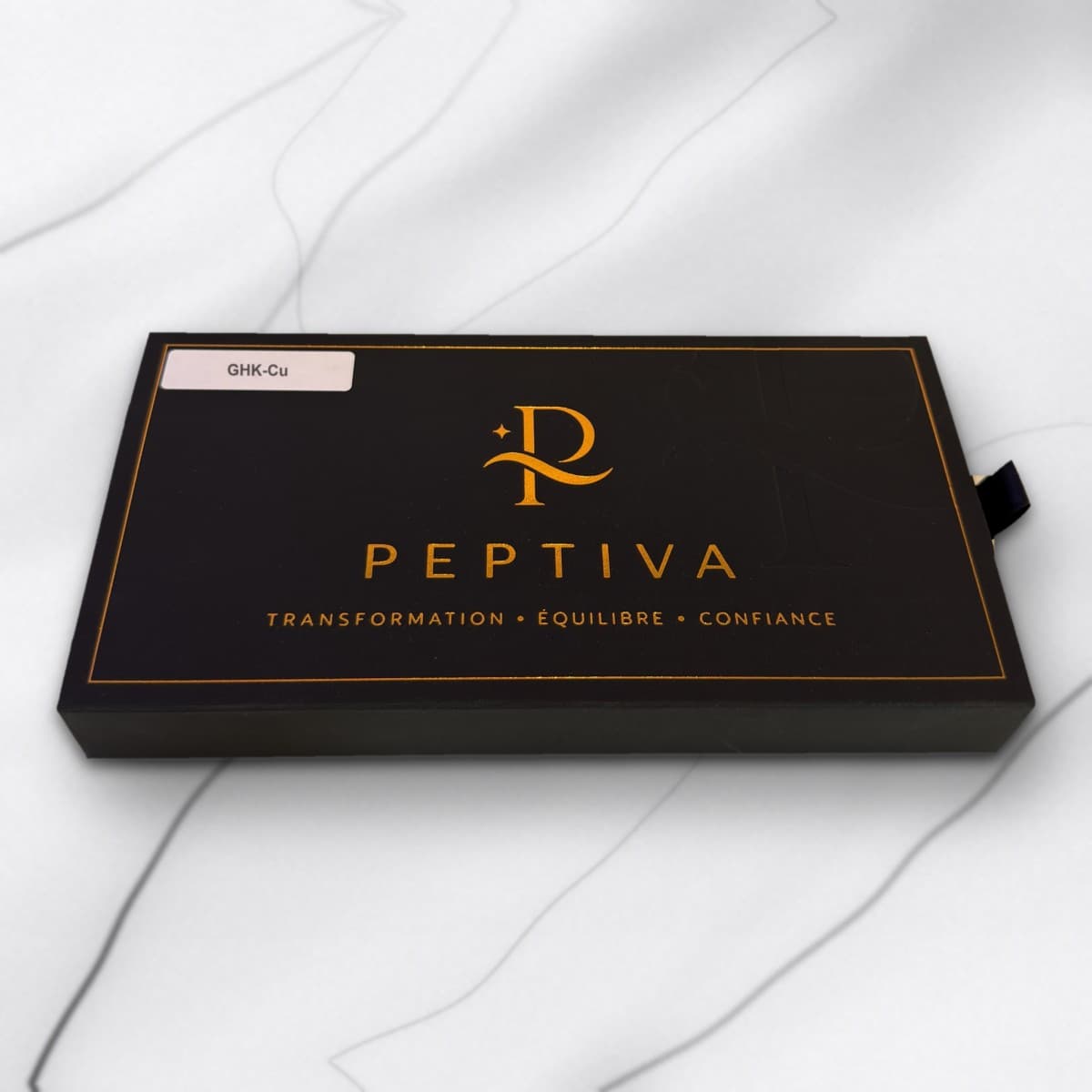
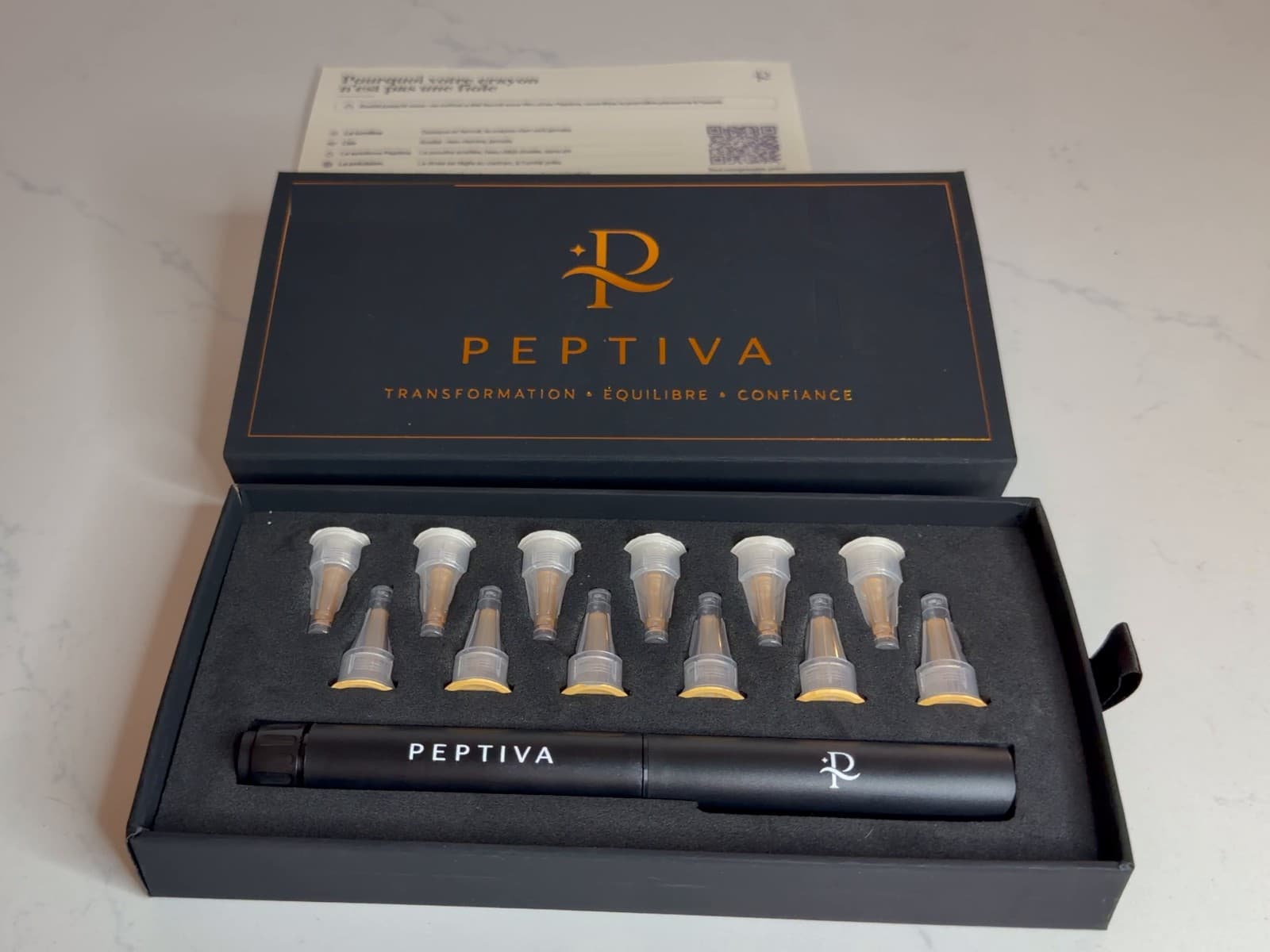
Injection aims at a general effect: the skin all over the body, connective tissue, recovery. A cream acts where it is applied, and that is the form the skin trials used. At Peptiva, GHK-Cu comes as a graduated pen, with its pre-measured water syringe.
Is copper dangerous?
The quantity of copper is minute and bound to the peptide. The risk concerns people whose body doesn't process copper normally, which is why it's contraindicated in Wilson's disease.
Why does the level decline with age?
Blood GHK levels drop by about 60% between the ages of 20 and 60. One hypothesis links this to skin aging and to slower healing with age.
Glossary (5)
- Collagen
- The most abundant structural protein in the body: it gives tissues their strength.
- Elastin
- A protein that lets skin and blood vessels spring back into shape after stretching.
- Glycosaminoglycans
- Large molecules (including hyaluronic acid) that hold water in tissues.
- Cofactor
- An element (here a copper ion) without which an enzyme can't function.
- Metalloproteinases
- Enzymes that cut up old collagen to allow remodelling.